OKR vs KPI: What's the Difference?
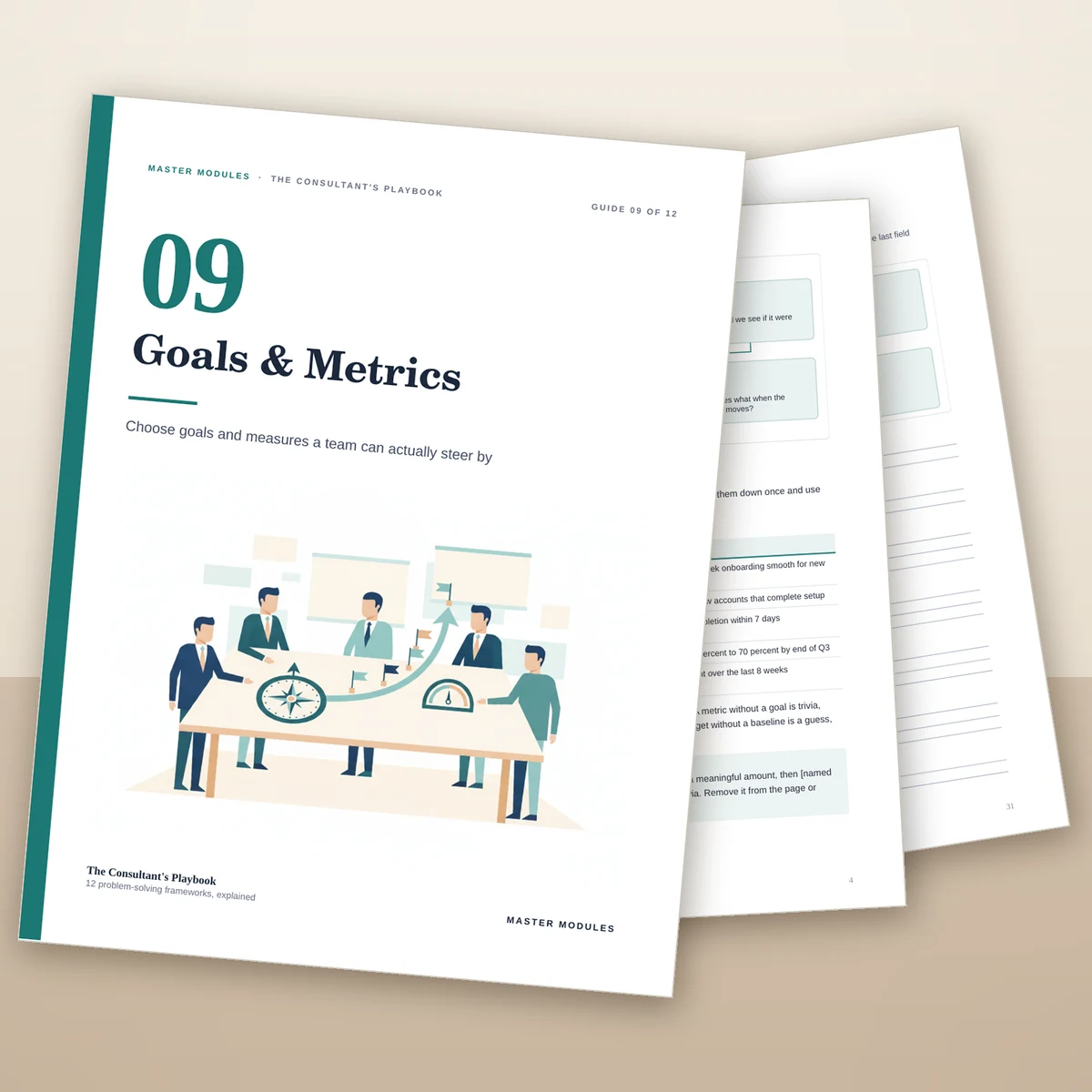
An OKR is a time-bound goal made of an objective and a few measurable key results. A KPI is a standing measure of how a process or business is performing. OKRs say where you want to go this quarter. KPIs say whether things are healthy right now. They answer different questions, and confusing them leads to goals that read like dashboards and dashboards that read like wish lists.
The short answer
| OKR | KPI | |
|---|---|---|
| Stands for | Objectives and Key Results | Key Performance Indicator |
| Purpose | Focus and change: move something | Monitor: keep an eye on health |
| Time frame | Usually a quarter | Ongoing |
| Form | One qualitative objective plus up to three measurable key results | A defined metric with a formula, owner and thresholds |
| Ambition | Often a stretch | Often a standard to hold |
| Question it answers | "Where are we going?" | "How are we doing?" |
| Reviewed | Weekly check-in, scored at the end | Regular rhythm, such as weekly or monthly |
A useful way to remember: KPIs are the gauges on the dashboard. OKRs are the destination you chose for this trip.
OKRs in more detail
The method was developed at Intel in the 1970s and spread widely through technology companies. State where you want to go in a sentence people can remember, then state how you will know you got there in a few numbers.
Objective: qualitative, time-bound, ambitious but plausible, within the team's influence and no numbers in it. "Launch the new help center" is a task. "Make customers able to solve most problems without contacting us" is a direction.
Key results: measurable outcomes with a baseline, a target and a date. Two people looking at the data at the end of the quarter should agree on whether it was met, without debate.
| Weak key result | Why it fails | Stronger version |
|---|---|---|
| Improve onboarding | No number, no baseline, no end | Raise 7-day setup completion from 54 to 70 percent by September 30 |
| Ship the setup wizard | A task; shipping does not prove it worked | Median time to first use falls from 3 days to 1 day |
| Hold a round of customer interviews | An activity; says nothing about the result | Reduce onboarding support contacts per new account from 1.8 to 1.0 |
Template: [Metric] moves from [baseline] to [target] by [date], measured by [source and definition]. Owner: [name].
Watch for the to-do list in disguise. If every key result starts with "launch", "build" or "complete", you have a project plan. Keep the plan, but move it under the key results as initiatives.
KPIs in more detail
A key performance indicator is a metric you promoted because it signals progress on something that matters. The word "key" is the discipline. It is one you would stop other work to investigate if it moved sharply.
Leading and lagging
- A lagging indicator reports a result after it happened: revenue, churn, defect rate.
- A leading indicator moves before the result and can be influenced now: trial sign-ups started, inspections completed, early sessions attended.
Pair them. A team that watches only lagging data steers by the rear-view mirror. A team that watches only leading data may optimize a signal that has stopped predicting the result.
Write a definition that survives a dispute
Most arguments about numbers are really arguments about definitions. Write each KPI down once.
| Field | What to write | Example |
|---|---|---|
| Name | Plain label that matches the dashboard | 7-day setup completion rate |
| Purpose | The goal this serves | Make first-week onboarding effortless |
| Formula | Numerator over denominator with exact filters | Accounts completing all four setup steps within 7 days / accounts created in the period |
| Exclusions | What does not count | Internal test accounts |
| Source and owner | Where the data lives and who answers for it | Product events table; Head of Onboarding |
| Thresholds | Green, amber, red | Green 70 percent or higher, amber 60 to 69, red below 60 |
Prefer rates to counts when volume changes, add a median and a high percentile when a few bad cases do the damage, and state the time window.
How they work together
- Choose your KPIs for the health of the business or process. These should be stable.
- Spot the gap. A KPI that is in the red, or a goal the KPIs do not cover, suggests the next objective.
- Write an OKR to move it: one objective, up to three key results, each with a baseline and a target.
- Often, a key result is a KPI with a target and a date.
- Score and learn at the end of the quarter, then decide whether the KPI is now healthy or the objective needs another round.
To find which lever to pull, a KPI tree connects the result to the things that drive it, the same way an issue tree breaks a question into parts. If you are setting baselines and need a rough target, a quick back of the envelope calculation can tell you whether a target is plausible.
Common mistakes
- Using OKRs as a to-do list.
- Using KPIs as goals without a time frame. A number that nobody is trying to move is just a number.
- Too many of either. Aim for a few objectives and a few KPIs per team.
- Committed and aspirational goals mixed. Label each, so a 70 percent result is not both a failure and a success.
- Tying scores to individual pay. It encourages safe targets.
- No thresholds. Without green, amber and red set in advance, every number gets debated.
Which one should you start with?
- If you have no regular measures, start with three to five KPIs and write their definitions.
- If you have plenty of metrics but little focus, start with one team and one objective.
- If you are running a project, set measures in the project charter.
- If you are improving a process, define baseline measures during SIPOC scoping.
Go deeper
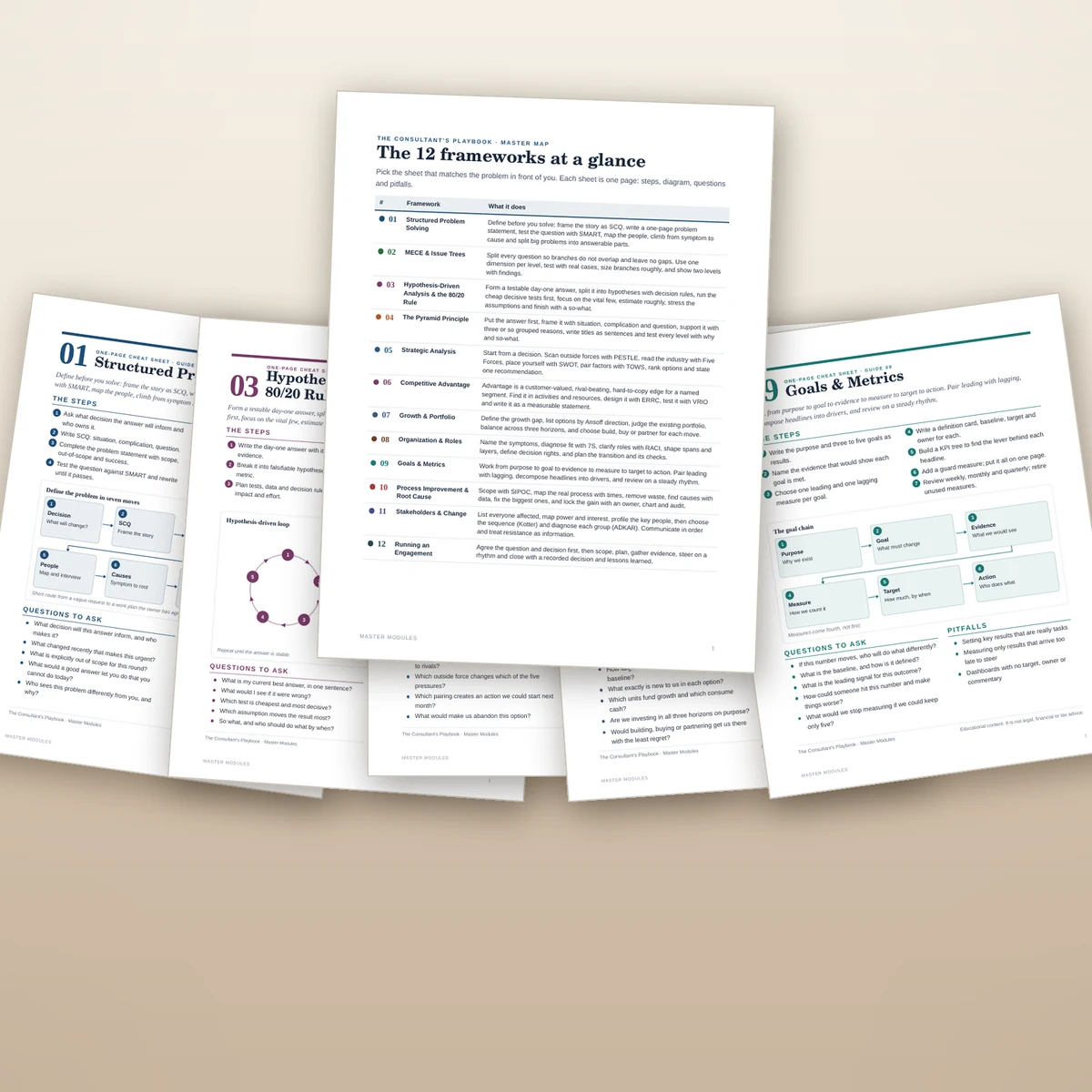
Guide 9 of The Consultant's Playbook follows the whole chain from purpose to measure: the goal chain, OKRs, KPIs, KPI trees, the balanced scorecard, dashboards people use and a review rhythm that avoids distorted incentives. It includes a fictional regional retailer case and three printable worksheets: Goal Chain and KPI Definition Card, OKR Draft, and KPI Tree Canvas.
Educational content. It is not legal, financial or tax advice.