Steering Committee Update: Agenda and Format
A steering committee is a small group of senior people who guide a project, make the key decisions and clear obstacles. A steering committee update is the short pack you bring to it, built around the decisions you need. The goal of the meeting is decisions, not a tour of your analysis.
What governance is for
Governance has a reputation for bureaucracy, but its job is simple: make sure the people who can decide or help know what they need at the right time. Over-governed projects drown in reports. Under-governed ones learn at the last minute that nobody agrees on the answer. Aim for the lightest rhythm that keeps surprises small.
A typical rhythm for a six to twelve week piece of work:
| Touchpoint | Frequency | Purpose |
|---|---|---|
| Team stand-up | Daily or several times a week | Coordinate the work |
| Weekly status note | Weekly | Keep sponsor and stakeholders informed |
| Sponsor check-in | Weekly or biweekly | Remove obstacles quickly |
| Steering committee | At each milestone | Decide |
| Issue and decision log | Continuous | Keep a record |
A 60-minute steering agenda
| Minutes | Item | What you ask of the group |
|---|---|---|
| 5 | Purpose and status against plan | Confirm the status |
| 15 | Key findings since last meeting | Challenge and add context |
| 15 | Options or recommendation (answer first, with action titles) | Choose, redirect or request more evidence |
| 15 | Risks, issues and support needed | Decide and assign owners |
| 10 | Decisions made and next steps | Confirm the record |
Send materials at least a day ahead, and treat the meeting as the place to decide. Leave at least a quarter of the time for discussion.
A one-page update format
Same format every time, readable in two minutes.
- Decisions needed today. Put these first, each with what, by when and a recommendation.
- Executive summary. The answer, the status and the key reason, in a few sentences. See how to write an executive summary.
- Progress against plan. Done this period, in outcomes rather than activities.
- Milestones. Planned date, forecast date, status.
- Key findings or results. One to three lines.
- Risks, issues and dependencies. Each with an owner, an impact and a date.
- Budget and resources. Only if relevant, and only variances.
- Next period. Three bullets.
Status template
Status: green / amber / red, with one reason. Done this period: three bullets. Planned next: three bullets. Early findings: one to three lines. Issues and risks: what, impact, owner, date. Decisions needed from you: what, by when.
Define the colors
- Green: on track for scope and date.
- Amber: a risk or slippage the team expects to recover with actions already in hand.
- Red: the date or scope will not be met without a decision or help from outside the team.
Use amber early rather than red late. Sponsors rarely mind a flagged risk but dislike a sudden red.
Pre-wire the important meetings
Speak to key members beforehand, one by one, particularly about findings that may be unwelcome. People who hear new and difficult information for the first time in a group tend to defend. People who have had time to digest it tend to engage. Pre-wiring is not manipulation if you are open about the content and willing to adjust.
Bring bad news early, with options
Every project has moments when something goes off plan. How you tell the sponsor shapes trust more than the problem itself.
- Deliver it as soon as you are reasonably sure.
- State the facts without blame.
- Quantify the impact on scope, timeline or quality.
- Bring at least two options and a recommendation.
- Say what you need and by when.
Example wording. "I want to flag an issue early: the data extract is incomplete and it affects the root-cause work. The impact is a four-day delay unless we change something. We see two options: use a sample for the first pass, or wait for the full extract. We recommend the sample, and we have a check in place to test it. What we need from you is a call by Thursday."
Watch the watermelon
A watermelon status is green on the outside and red inside: reports say all is well while the team knows otherwise. It happens when people fear the reaction to bad news. Make it safe to report amber by responding to early warnings with help, not blame.
Keep two simple logs
- Issue list: the problem, owner, due date and status.
- Decision log: each decision, who made it, the date and the reason.
When a question comes up six weeks later, such as why the second supplier was excluded, the log answers in seconds and prevents arguments over memory.
Example: an amber that helped
In week three of a fictional furniture review, the status turned amber because two key interviewees were unavailable. The note said so, with a proposal: replace one with a delegate and move one interview by a week. The sponsor cleared the second interviewee's diary in a day, and the status went back to green. Had the team waited until week five, the delay would have been a red.
Checklist before the meeting
- Decisions needed are listed first.
- Status colors are defined and used consistently.
- Materials went out ahead of time.
- Key members were pre-wired on sensitive findings.
- The issue and decision logs are current.
- Each risk has an owner.
How it connects to the rest of the project
The committee works from the scope and objectives agreed in the project charter. The roles shown in a RACI matrix tell you who should be in the room. At the end, the final steering meeting feeds the decision memo and the lessons-learned review.
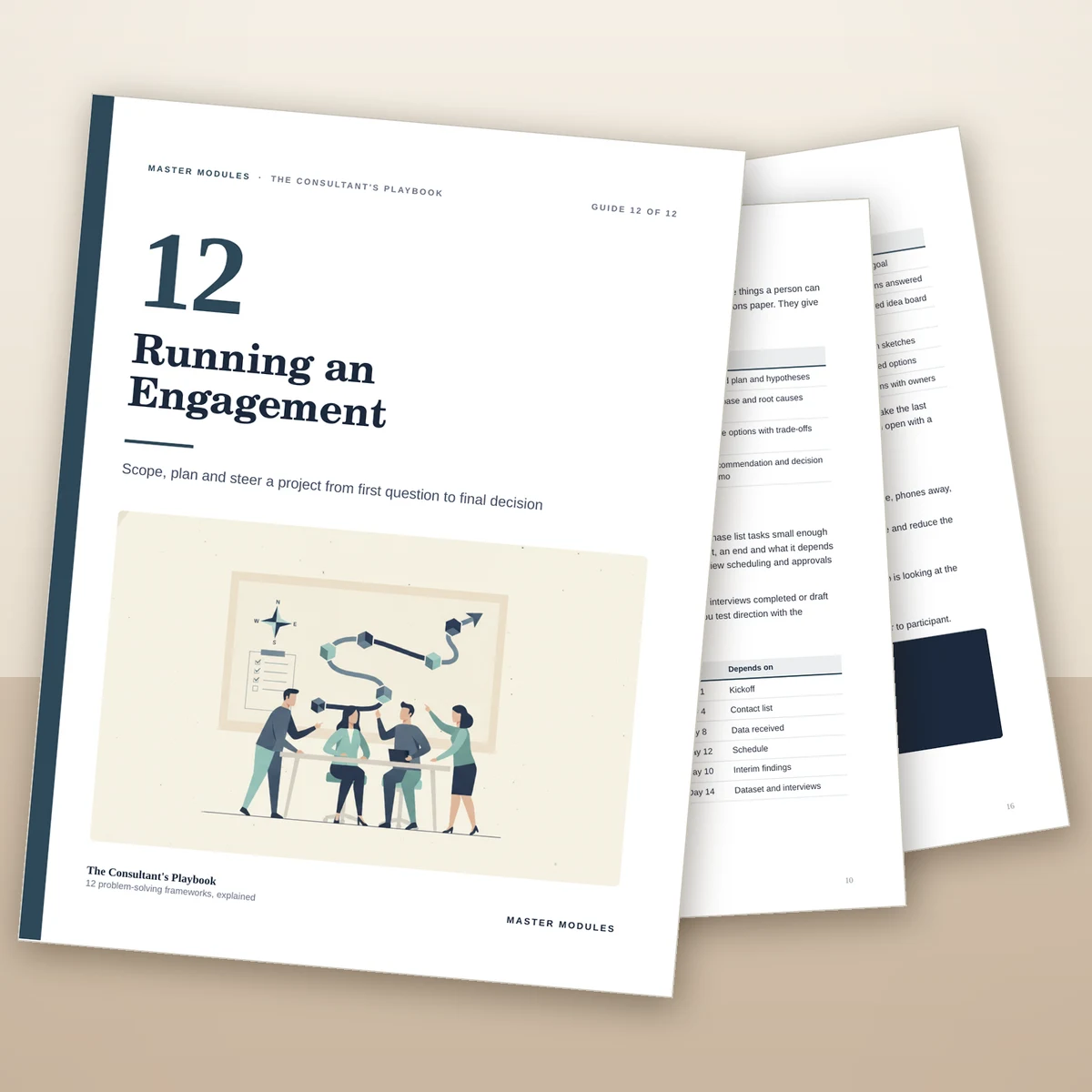
Go deeper
Guide 12 of The Consultant's Playbook covers steering committees and status reporting in its own chapter, along with scoping, proposals and workplans, interviews, workshops, the decision memo and the close. It includes a fictional furniture retailer case and a printable Workplan and Risk Log worksheet.
Educational content. It is not legal, financial or tax advice.