5 Whys Template: How to Find the Root Cause
The 5 whys is a root cause technique: state a specific problem, ask "why did this happen?", then ask "why?" again of each answer, until you reach a cause in the process that you can change. Five is a rule of thumb. It is the simplest root cause tool, and used carefully it turns a symptom into a system problem. Used carelessly it ends in blame.
5 whys template
Copy this table into a document or onto a whiteboard.
| # | Question | Answer (a fact you can check) | Evidence |
|---|---|---|---|
| Problem | What happened, where and when? | ||
| Why 1 | Why did this happen? | ||
| Why 2 | Why did that happen? | ||
| Why 3 | Why did that happen? | ||
| Why 4 | Why did that happen? | ||
| Why 5 | Why did that happen? | ||
| Root cause | The process condition we can change | ||
| Action | One action per root cause | Owner and date | |
| Check | How will we know it worked? | Measure and review date |
Worked example
All details are fictional. A small online shop shipped the wrong size of a jacket on Tuesday.
| # | Question | Answer |
|---|---|---|
| Problem | Order shipped with the wrong size | Customer received a medium instead of a large |
| Why 1 | Why was the wrong size shipped? | The packer picked the wrong item |
| Why 2 | Why was the wrong item picked? | The two sizes sit side by side and look alike |
| Why 3 | Why is it hard to tell them apart? | The label shows the size in small print |
| Why 4 | Why is the size in small print? | The label template was changed last season and no one checked it |
| Why 5 | Why did no one check it? | No one owns label templates |
The root cause is not the packer. It is that nobody owns label changes.
Check the logic backwards
Read the chain from the bottom up and add "therefore" between each pair: "No one owns label changes, therefore the template was not checked, therefore the size is in small print, therefore the sizes look alike, therefore the packer picked the wrong one." If any link sounds weak, go back and gather more evidence.
Turn it into actions
| Root cause | Action | Owner | Check |
|---|---|---|---|
| No owner for label templates | Name an owner and add a review step on range changes | Operations lead | Review logged for every range change |
| Labels do not highlight size | Redesign with a large size block | Packaging designer | Wrong-size picks per 1,000 orders, weekly |
| Look-alike items side by side | Separate adjacent sizes on the shelf | Warehouse supervisor | Shelf audit, monthly |
Six rules that keep it honest
- Start with a specific problem, such as "the wrong size shipped on Tuesday", not a general complaint.
- Answer with facts, not guesses. Each answer should be something you can observe or find in the data.
- Ask about the process, not the person. "Why did the packer make an error?" leads to blame. "Why was it easy to make this error?" leads to a fix.
- Stop at a cause you can act on. Going further, to human nature or the economy, is not useful.
- Check the logic backwards with the "therefore" test.
- Allow branches. Many problems have more than one cause. Follow each branch separately.
Examples of branching
A fictional clinic investigates why a patient waited 90 minutes. Why? The doctor started late. Why? The previous visits ran over. Here the chain splits.
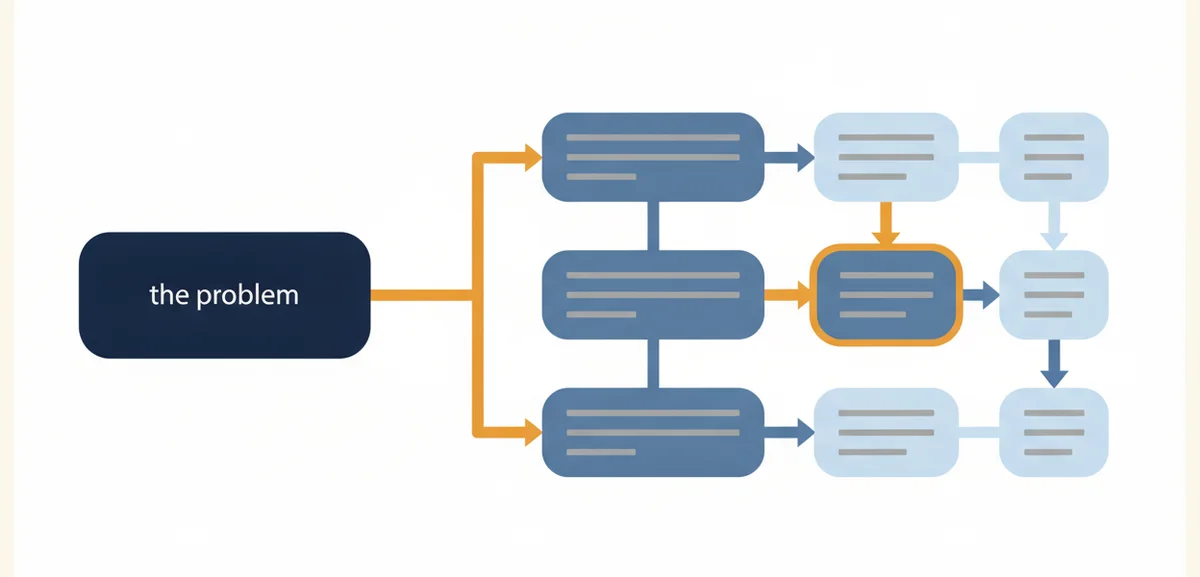
- Branch A: visits are booked at 15 minutes, though new-patient intake takes 30. The scheduling template has no new-patient slot.
- Branch B: the room was not turned over because supplies were missing. Restocking has no schedule.
Each branch ends in a different fix. A single chain would have found one of them.
Where the 5 whys fails
| Pitfall | What happens | Remedy |
|---|---|---|
| Stopping at human error | Ends with "the packer was careless"; nothing changes | Ask why the system allowed the error |
| Single chain | Misses other contributing causes | Branch where more than one answer is true |
| Opinion as fact | A plausible but wrong cause gets fixed | Verify each answer with data or observation |
| Leaping to a favorite solution | The chain is bent to justify a pre-chosen fix | Write the chain before discussing solutions |
| Stopping too early | Fixes a contributing factor, and the problem recurs | Ask whether removing this cause would prevent recurrence |
Go to the place
A session in a meeting room tends to produce plausible stories. The better practice is to ask the questions where the problem occurred, with the people who were there, looking at the actual item or record. Fifteen minutes at the shelf will often change the answer to the second "why".
A short session plan
- Write the problem as one specific event or pattern, with date and place.
- Gather the people involved and, where possible, stand where it happened.
- Ask "why" and write each answer on its own card. Keep only answers backed by evidence.
- Where an answer has two causes, split into branches.
- Stop at a cause in the process that you can change.
- Run the "therefore" test, then write one action per root cause with an owner and a check.
When to use something stronger
The 5 whys gives a hypothesis, not proof. When the process is complex or the stakes are high, use it to generate candidate causes, map the wider set with a fishbone diagram and confirm with data. Scoping first with a SIPOC diagram keeps the investigation within the right process. The conclusions belong in a lessons-learned review so the next team benefits, and if a fix meets pushback, see resistance to change.
Go deeper
Guide 10 of The Consultant's Playbook covers the 5 whys in its own chapter, with the rules, the pitfalls, branching and the action table above, followed by fishbone diagrams, Pareto analysis and a control plan. The Root Cause Fishbone and Control Plan worksheet is a printable frame for your own investigation, and the fictional catering case walks a full improvement project from definition to lasting control.
Educational content. It is not legal, financial or tax advice.