Resistance to Change: Causes and How to Respond
Resistance to change is pushback from people affected by a change, and it is best treated as information. When people resist, many project teams react as if they were fighting the people. A more productive frame is that resistance is data: it tells you something about the change, the process or the relationship has not been addressed. Sometimes the resisters are wrong. Sometimes they have spotted a real flaw. You cannot know until you listen.
Why people resist: five causes
Seeing which cause you face determines the response.
| Cause | What you may hear | Helpful response | Avoid |
|---|---|---|---|
| Loss | "This makes my job pointless." | Name the loss, clarify the new role, offer skill-building and a voice in the transition | Pretending nothing is lost |
| Understanding | "Why are we doing this?" | Share the business case and examples; invite questions | Repeating the same slide louder |
| Trust | "We have heard this before." | Make small commitments and keep them visibly; be open about what happened last time | Big promises |
| Capacity | "We have no time for this." | Remove or defer other work; schedule protected learning time | Telling people to find the time |
| Disagreement | "This will not work because…" | Test the claim, adjust the design if warranted, explain the choice if not | Dismissing it as negativity |
The last category deserves attention. A nurse who says a new form will slow medication rounds may be right. Treat substantive objections as input to design, and show people the change you made in response.
A four-step response method
- Listen without defending. Ask what concerns them and let them finish. Restate it to confirm you understood. Avoid arguing yet.
- Diagnose the cause. Use the five categories above and the blocks of the ADKAR model. Is it loss, misunderstanding, distrust, capacity or valid disagreement?
- Respond to the cause. Facts for misunderstanding, acknowledgment and support for loss, a fix for a valid problem, time or resources for capacity, a track record of promises kept for trust.
- Follow up. Tell the person what you did with their input, even if the answer is no. People forgive a no that was explained far more easily than silence.
Ask the one-level-up question
Behind most objections is a concern about something larger: safety, fairness, competence or respect. After someone states an objection, ask, "and what would that mean for you?" The second answer is usually the real one.
Example conversations
Capacity. A supervisor says the new logging task is impossible on a short-staffed shift. The cause is not unwillingness but workload. The response is to trade the task for a lower-value report, not to repeat the training.
Trust. A team says, "We were promised a new system two years ago." The response is a small commitment with a date, kept visibly, before any large announcement.
Disagreement. An analyst argues that the new template drops a field regulators ask for. The response is to check the claim. If it is right, change the template and tell the analyst. If it is wrong, explain why with the evidence.
Diagnose with stakeholders in mind
Resistance is rarely uniform. Map who is affected, how strongly and with what interests, so that you respond to each group differently. A stakeholder map plus a profile card for key people, showing what they need, fear and influence, is a good place to start. The root cause behind a group's reaction can also be explored with the 5 whys, taking care to ask about the process and the situation, not about the person.
When resistance persists
Occasionally a person remains opposed after concerns have been heard and addressed, and their behavior blocks others: ignoring the new process, discouraging colleagues or withholding needed cooperation. At that point it is a performance and leadership matter, not a communication one. The manager should:
- state the expectation clearly,
- describe the specific behavior and its effect,
- offer support and a timeline, and
- follow the organization's own process, involving HR or a senior leader where required.
This step comes after listening and diagnosis, not before.
Make the change stick
Many changes work during the project and decay after the team moves on. To anchor a change, treat the end of the project as a handover.
- A named line owner is responsible for the new way of working after the project closes.
- Procedures, job descriptions and onboarding materials are updated.
- The old tool, form or path is switched off, not merely discouraged.
- Adoption is measured with two or three indicators, reviewed monthly for at least one quarter.
- A short review at 30, 90 and 180 days asks: what stuck, what slipped, why?
Example. A fictional logistics company reviewed its delay-logging change at ninety days. Overall usage looked healthy, but one depot sat at half the average. A visit found that the depot's tablets lost connection in the yard and supervisors had gone back to calling the desk. A signal booster and an offline mode fixed it. Without the group-level view, the average would have hidden the problem.
Common mistakes
- Treating resisters as enemies.
- Answering every objection with the same message.
- Ignoring valid objections.
- Announcing without following up on what you heard.
- Declaring victory at launch and not measuring adoption.
- Leaving the old way available, so nothing makes people change.
How it fits with change models
Organization-level models such as Kotter's eight steps tell you what leaders do to build urgency, enlist a coalition and remove obstacles. A steering committee gives you the place to raise adoption problems early. Resistance work is where the two meet real people.
Go deeper
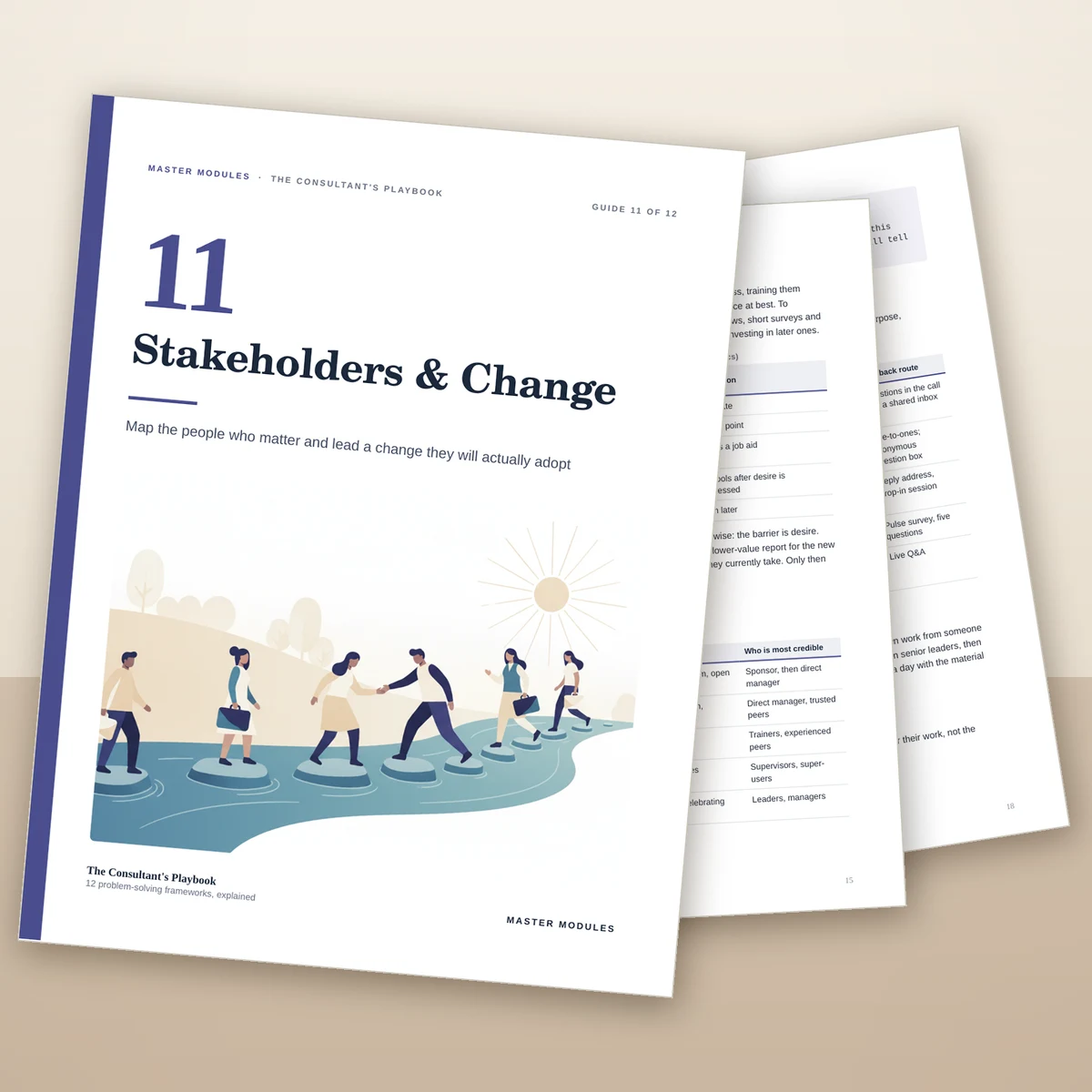
Guide 11 of The Consultant's Playbook gives resistance its own chapter, including a fishbone diagram of root causes, a response table, a script for hard conversations and a 30-90-180 day review checklist. It also covers stakeholder profiles, communication plans, Kotter and ADKAR. It includes a fictional logistics case and a Stakeholder Profile Card worksheet.
Educational content. It is not legal, financial or tax advice.