VRIO Framework: How to Test a Competitive Advantage
VRIO is a test for whether a resource or capability gives a company a lasting competitive advantage. It asks four questions in order: is it Valuable, Rare, costly to Imitate, and does the firm have the Organization to exploit it? It rests on the resource-based view of strategy, popularized by Jay Barney in the early 1990s, which argues that lasting advantage comes from things rivals cannot easily obtain.
The four questions
| Letter | Question | If the answer is no |
|---|---|---|
| Valuable | Does it help the firm exploit an opportunity or neutralize a threat? | It is a disadvantage. Fix it or drop it. |
| Rare | Do few or no competitors have it? | Competitive parity. Necessary, but not a differentiator. |
| Imitate (costly to) | Would it be expensive or slow for rivals to copy or acquire? | A temporary advantage. |
| Organized | Is the firm set up to capture the value, through processes, incentives and structure? | An unused advantage. |
Stop at the first "no". Each "yes" moves you one step further.
How to read the results
| Valuable | Rare | Costly to imitate | Organized | Implication |
|---|---|---|---|---|
| No | – | – | – | Competitive disadvantage: fix or drop |
| Yes | No | – | – | Competitive parity: needed to stay in the game |
| Yes | Yes | No | – | Temporary advantage: exploit quickly and keep innovating |
| Yes | Yes | Yes | No | Unused advantage: fix the organization to capture the value |
| Yes | Yes | Yes | Yes | Sustained competitive advantage |
Why some things are costly to imitate
Resources are hard to copy for four common reasons.
- History. They took years to accumulate, such as a reputation or a data set.
- Causal ambiguity. Even insiders cannot say exactly why the system works, so outsiders cannot reproduce it.
- Social complexity. They depend on relationships, trust and culture.
- Legal protection. Patents, licenses or contracts block copying.
VRIO analysis example
A fictional repair firm, Granite Ridge Service, asks about its apprentice program, which produces technicians trained on discontinued equipment.
| Question | Answer | Evidence |
|---|---|---|
| Valuable? | Yes | Customers cannot afford downtime on their older machines |
| Rare? | Yes | No rival trains on this equipment line |
| Costly to imitate? | Yes | It takes five years and depends on retired mentors |
| Organized? | Partly | Scheduling does not always route the right technician to the right job |
Result: a sustained advantage that is not yet fully exploited. The cheapest next step is organizational: change how jobs are routed so that the scarce skill reaches the customers who value it.
Template
List ten to fifteen resources and capabilities and fill in this table.
| Resource or capability | Valuable | Rare | Costly to imitate | Organized | Implication | Confidence | Review date |
|---|---|---|---|---|---|---|---|
| high / medium / low |
Take the resources from the firm's value chain: assets, skills, data, relationships, brand and processes.
How to use it in practice
- List the resources and capabilities, at a level specific enough to test.
- Answer the four questions with evidence, not opinion. Mark uncertain answers.
- Classify each into disadvantage, parity, temporary advantage, unused advantage or sustained advantage.
- Decide what to do: protect and invest in the sustained and unused ones; maintain parity items at the lowest adequate cost; stop spending on items that fail the first test.
- Revisit annually, because rarity and imitation costs change.
Pitfalls
- Scoring the company instead of the resource. Test specific resources.
- Confusing rare with unique to you today. A supplier contract that expires next year is rare for now, not for long.
- Ignoring the organization question. Many firms hold valuable and rare assets that sit idle because incentives or processes do not use them. Fixing that is often the cheapest path to advantage.
- Treating the result as permanent. Put a review date on every classification.
- Self-flattery. Teams tend to rate their own resources as rare and hard to copy. Ask an outsider, such as a customer, a supplier or a former employee of a rival, to challenge the "Rare" and "Costly to imitate" answers.
A useful way to keep the exercise honest is to attach a confidence level to each answer: high when you have data or customer statements, medium when you have informed estimates, and low when you are guessing. Items with low confidence and high importance become research tasks.
Parity is not a failure
VRIO also guards against a quiet error: investing heavily in parity resources and expecting an edge. Matching rivals on response times or website quality is necessary because customers expect it, but it will not make customers choose you. Treat those as the cost of admission and put differentiating effort where VRIO says it counts.
Questions to ask in the room
- Which of our assets would a well-funded rival still struggle to copy in three years, and why?
- This is valuable but common. It keeps us in the game, so we maintain it, not celebrate it.
- We have the capability, but our processes do not use it. That is an organization problem, not a resource problem.
- Who outside the company could test whether this is really rare?
How VRIO fits with other tools
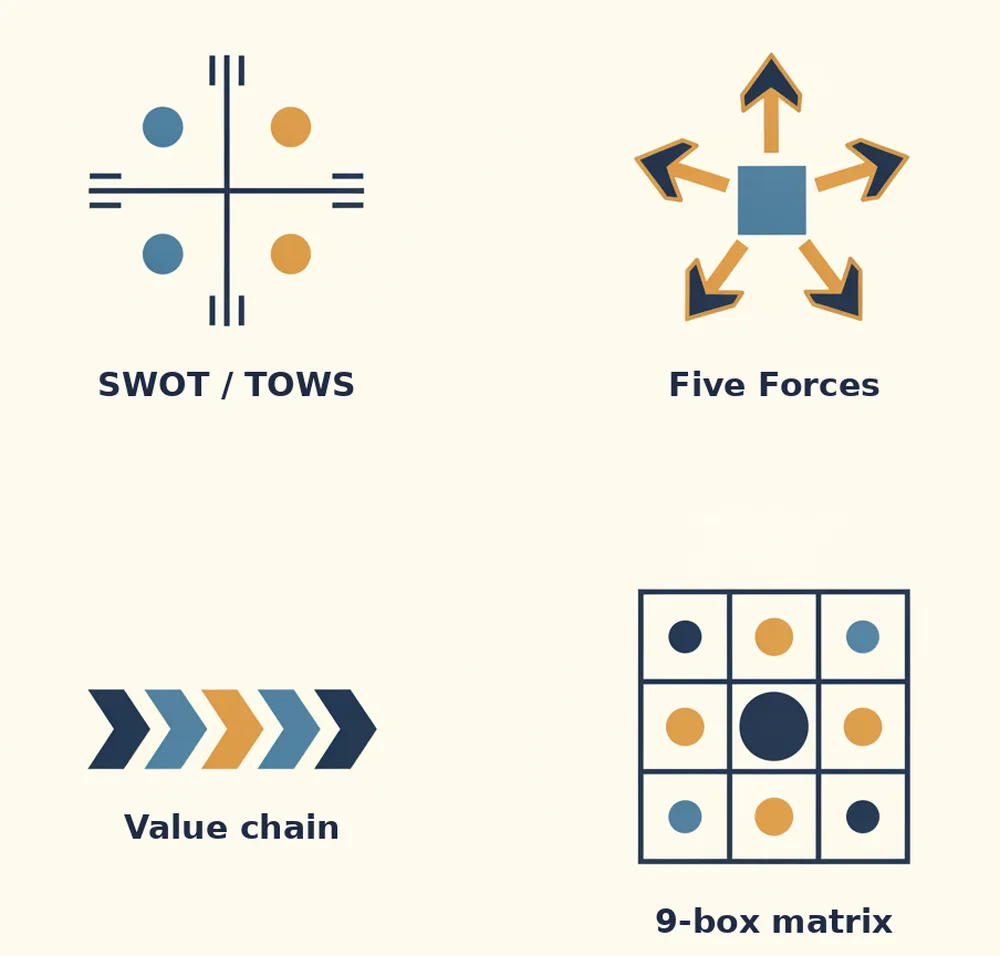
VRIO looks inside the firm. A TOWS matrix pairs internal strengths and weaknesses with outside opportunities and threats to generate options, and VRIO can tell you which strengths on that list are worth building on. To structure the resource list so that nothing overlaps or is missing, use an issue tree. To present your result, lead with the answer as described in the pyramid principle guide.
Go deeper
Guide 6 of The Consultant's Playbook covers what competitive advantage is, the value chain, generic strategies, VRIO, customer jobs and the ERRC grid, then pulls them into one advantage statement and stress test. It includes a fictional mobile-glass repair case and a worksheet called VRIO Table and Customer Jobs.
Educational content. It is not legal, financial or tax advice.